Sunday, January 24, 2010

Another incidental relic

While I continue to research Ellis Island (trying to track down the name of the documentary I saw in the eighth grade, mostly), I was searching through my photos of last May's trip to New York to see what I'd taken there, and ran across another incidental relic, spotted as we headed through Battery Park towards the ferry that would take us to visit Liberty Island and Ellis Island. It looked familiar:

I had some time to think about it over the next three hours or so. By the time I returned, I was 99% sure I knew what it was, because in 1985 I once sat down right next to it.


This was -- and is-- "The Sphere" by Fritz Koenig, and it once sat in the plaza in front of the World Trade Center. It awaits return to its original site, where it will be part of the World Trade Center memorial Given what happened around it, it survived remarkably well.

The dish-like structure to its right in my photo is an eternal flame.


This is the World Trade Center site itself. You get a better sense of what went before if you go to the little memorial site set up in a storefront across the street on the south side and look north. They've provided you with some photos of what it looked like from the same storefront window before the towers fell, and if you had ever been there before--and I had--suddenly they spring back into place.

Thursday, January 21, 2010

Old ruins, new finds

One of the joys of researching some of my favourite ruins is coming across other people who have the same passion for the abandoned that I do. I am working on a fairly good-sized post or two on Ellis Island, which I discovered in Grade 8 in a movie that probably bored 75% of the rest of the class to tears.

In looking for images, I ran across Phillip Buehler's Modern Ruins site. I won't reproduce his Ellis Island photos here, but I highly recommend taking a look.

I will, however, link to one photo, because there is a story that goes with it.


My husband and I were touring the SS Olympia in Philadelphia (fascinating transitional period warship; Admiral Dewey's flagship in the Spanish-American War). We looked south and saw the unmistakable shape of steamship funnels seemingly parked right there in the Delaware River. "What on earth is that?" we wondered.

It was--and is--the SS United States, one of the last great classical era passenger liners, the largest ever built in the US, completed in 1952. To this day, it still holds the Blue Riband (westbound), given to the passenger liner with the speed record for crossing the Atlantic. It was taken out of service in 1969 and stripped of its finishings in 1984. Asbestos was removed in 1992 as part of a plan to return it to service It is currently derelict and docked permanently across from an IKEA. It's owned by a cruise line, and periodically rumours that it will be restored surface, but other rumours also circulate that it will be sold for scrap.

A number of groups are fighting to save it, including the SS United States Conservancy. I hope they are successful. There are so few actual ships left from this era, an era that began with the great luxury liners such as Titanic. Most are either at the bottom of the ocean or have long since been scrapped.

Thursday, January 14, 2010

Wounded Land I'll Never See

I prefer my ruins to be created the old fashioned way, through years of decline and neglect. If they are the result of a catastrophic event, I prefer that the horror of that event will have receded in history so that we can only guess at what the victims might have gone through.

Haiti is not that kind of ruin.


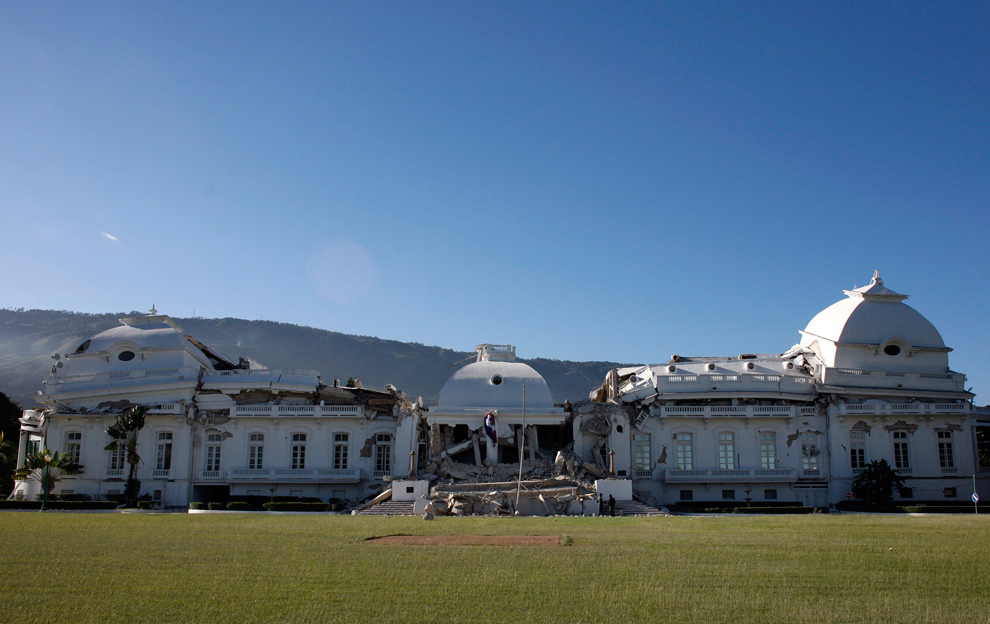
The images above are of the Presidential Palace. The building has pancaked, like many other buildings in Port-au-Prince. Washington Post writer Lee Hocksteder filled in a little background about this building, "almost a mirage in a city of mean, sprawling slums, rickety tin shacks and jury-rigged infrastructure." It was built in the 1920s when the US Marines occupied Haiti. Haiti has a tragic history of violence and corruption under the infamous Duvaliers and their successors, but recently had achieved a fragile measure of stability under Rene Preval. However, the country remained the poorest in the Western Hemisphere, with 80% of its people in poverty, 50% in abject poverty. The Presidential Palace was in some ways a beacon of hope, something Haiti could be proud of.

Hope for Haiti will come from elsewhere now.


The video is Arcade Fire's beautiful song "Haiti." Singer Regine Chassagne is of Haitian descent. They're suggesting donations to Partners in Health, an organization they also supported on their last tour. Given the Canadian Government's offer to match donations made by Canadians, I have taken them up on this suggestion. This is also the group that will receive the $5 donations made by texting HELP to 1291 on Rogers cell phones.

Monday, January 4, 2010

Paul's Church, with all the roof fallen

Last week I caught a show on the building of St. Paul's Cathedral in London. The building is so iconic (and such an interesting feat of engineering) that few people remember what came before.

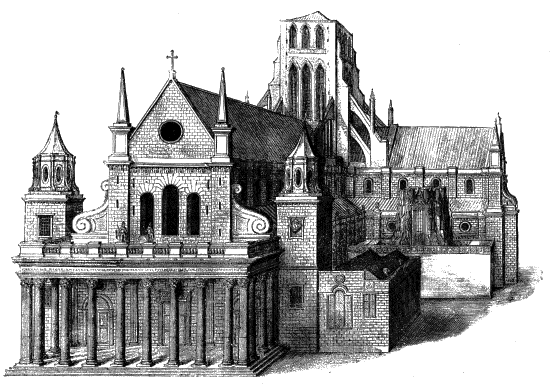
Old St. Paul's was one of the largest Gothic cathedrals in Europe, with an enormous nave known as "Paul's Walk", beautiful stained glass and the tallest spire in Europe.


It was not just a pretty building, but became the centre of London life--its nave was used for business, for learning the latest news, and later, during its decline, for all manner of buying and selling. London's booksellers were located nearby on Pater Noster street. But, like many churches, the Reformation was not kind to it. By the 16th century it had begun its long decline, and was actually sacked by a mob. Horses were even bought and sold there at one point. In 1561 the spire was destroyed by lightning. A belated attempt to stop the decline was made with the addition of a classical portico in the 1630s.


However, at the moment of its death there had been hope--scaffolding had gone up to start a long-promised restoration. The scaffolding instead contributed to its demise in the Great Fire of 1666.


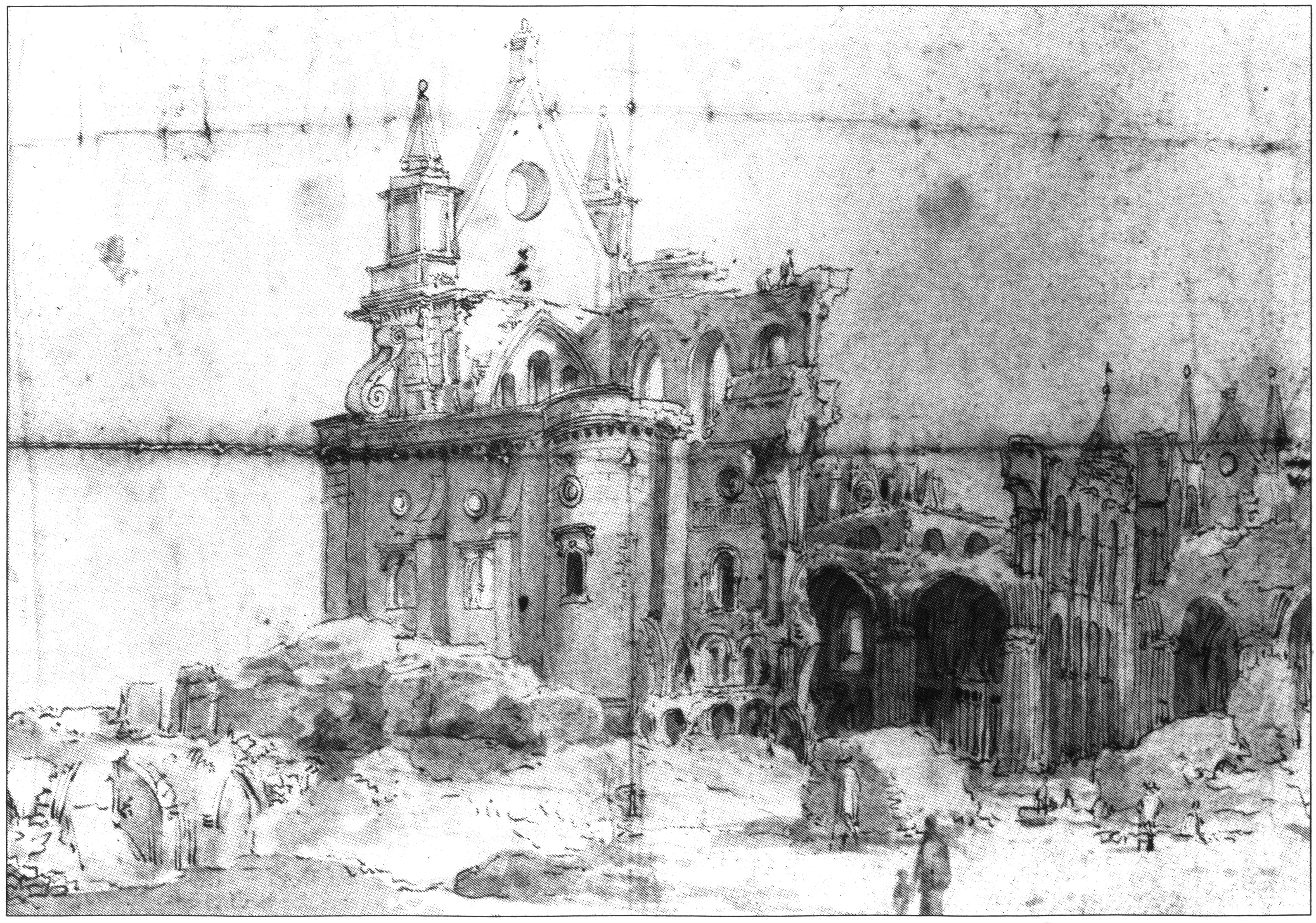
The cathedral lay in ruins for many years while debates raged as to what to do next--restore what was left, rebuild in a similar style, or build something completely new. The decision was eventually made to give the commission to Christopher Wren, who had done an initial investigation into restoring the church before the fire. In the meantime, the ruins stood:


The ruins did not come down until 1675, and were apparently tougher than they looked. When it came time to lay out the new church, a piece of gravestone was used to mark the centre of the new dome. Upon that gravestone, one word: Resurgam. (I shall rise again). And it did.

I retain my fondness, however, for the beautiful cathedral which fell into ruins and then perished in the fire. The sad depictions of its last few years, with its truncated spire, are particularly evocative. Today, nothing remains but a few scattered remnants of funerary momuments of the old, where bishops and counts and poets were buried--just enough to recall what came before.

Wednesday, December 30, 2009

Remains of the day

My photos of all that remains of the Larkin Administration Building in Buffalo:


You can actually see the Larkin Factory from I-190 on the south end of Buffalo. The area where the building was located is somewhat deserted--a number of boarded-up buildings--although not abandoned. In my second photograph (of the extant retaining wall, which is a somewhat less elegant remnant), you can see the factory off to the left.

I drove in from the east and bore right on Swan to get to the remaining fence pier. This gave me an opportunity to visualize the missing building, which would have sat aside the triangle of land in a fairly arresting way.

I've seen a few sites misunderstand exactly what this remaining piece of one of the most beautiful office buildings ever built is. It's not a remnant of the building itself--it did not "hold up a corner". It is an intact fence pier. Most of the fence itself (as can be seen in the second photo) remains. The reason is evident once you see the site: there is an embankment behind the fence, and it functions as a retaining wall. If it weren't for that fact, there would likely be nothing left of the Larkin Administration Building at all.

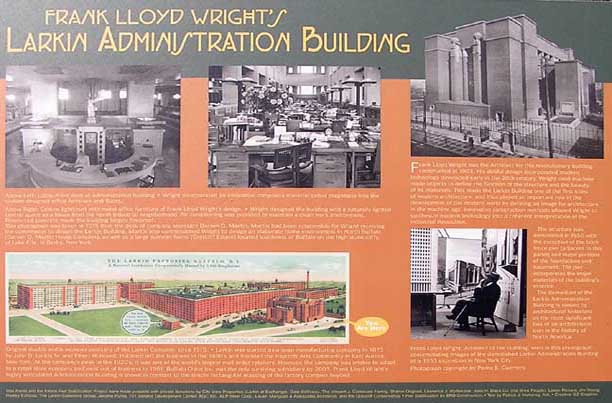
I did not actually get out of my car to visit the plaque at the site, as it was quite snowy and I had not brought my boots. This is what is on the plaque:


I always find these accidental relics to be the most poignant. If it weren't for this rather desolate piece of wall, would anyone have a reason to drive down this deserted street any more?

Friday, December 25, 2009

On Christmas Day

It looks like the historic All Saints Church in Whitby will be saved despite the devastating fire eleven days ago.


Recent reports are that the walls and steeple are stable. The salvageable stained glass has been removed and preparations are being made to cover the roof that was destroyed with a temporary structure. Last night's news stated they'd like to be back by Easter, 2011.

In the meantime, another local church is providing space to them, and donations covered all of the hampers for the needy that were also lost.

Arson is still suspected, but has not been officially confirmed.

Here is a nice Flickr set of the church, both before and after.

Thursday, December 24, 2009

Larkin Building pre-visit

I just learned today that if all goes well, I should have a reason to go to Buffalo on Monday. As I mentioned in my last post, I have been planning to stop by the Larkin Administration Building site for some time to photograph its last remnant. I wanted to make sure I knew where it was, however, so I did a little research.

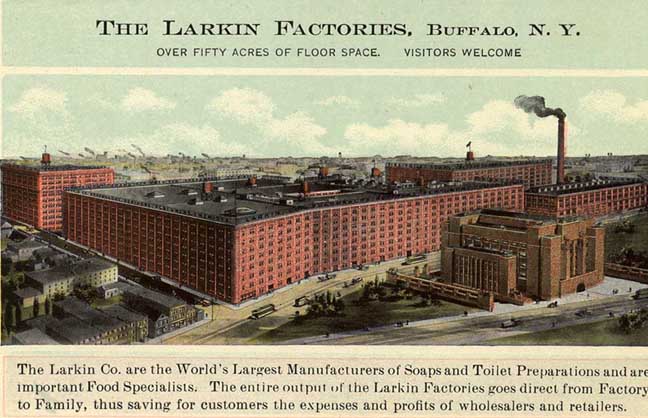
The Larkin Administration Building was designed by Frank Lloyd Wright in 1904 and completed in 1906 to house the offices of the Larkin Soap company. (The huge factory buildings adjoining the offices still exist.) The building was the first office building to be air conditioned. If you've ever been to a building with a multi-story atrium that provides natural light from above, you're looking at the legacy of the Larkin Building. Its interior was what was so revolutionary, especially when it was built.


Just as the Depression was not kind to the Darwin Martin family and eventually resulted in the abandonment of the Martin House, the affairs of Darwin Martin's employer, the Larkin Soap Company, were also in dire straits. The Larkin building was transformed into a retail store in 1939, but sold in 1943. Eventually the building entered foreclosure and was abandoned. The City of Buffalo attempted to sell it several times and considered a variety of alternate uses, including government offices and a recreation centre, but in its abandonment the building was deteriorating.


It was eventually sold for a mere $5000 and demolished in 1950. It apparently was a major pain to tear down--it was very well-built.

Here's what the building looked like alongside the huge factory:


Here is a Google map of the site:


View Larger Map

And how the site looks in Google Street View:

View Larger Map

If you head further west along Swan St. in Street View, you can see the remaining fence pier (it was part of the fence that can be seen at the back of the postcard of the offices and factory above) This will be what I'll be visiting next Monday.